August 12, 2026
CO2 Enrichment in Commercial Cannabis: What Actually Works


Supplemental CO₂ is one of the few inputs in indoor cultivation that reliably increases yield. It is also one of the most misunderstood, because that yield only shows up when everything else in the room is already dialed in. Run it wrong and you are paying for gas that never makes it into the plant.
Here is what the evidence actually supports, what it does not, and every setpoint that has to move on the day you turn the gas on.
Why enrichment works at all
Cannabis is a C3 plant C3 photosynthesis The carbon fixation pathway used by cannabis and most crops, named for the three-carbon compound it makes first. C3 crops gain from added CO2 because ambient levels leave them carbon-limited. , which is the whole reason supplemental carbon does anything. In a C3 plant, carbon dioxide is captured directly by RuBisCO RuBisCO The enzyme that captures CO2 and commits it to sugar. It is slow, hugely abundant, and it also reacts with oxygen, which is the flaw that makes photorespiration possible. , and that enzyme carries a flaw: it accepts oxygen about as readily as it accepts carbon dioxide.
When it grabs oxygen instead, the plant runs photorespiration Photorespiration A wasteful side reaction in which RuBisCO binds oxygen rather than CO2, costing energy and releasing carbon the plant had already fixed. It worsens as temperature rises and eases when CO2 is elevated. , a salvage pathway that burns energy and hands back carbon the plant had already fixed. At the roughly 420 ppm in outside air, a real share of a cannabis plant's photosynthetic capacity goes out this way. Raising CO₂ in a sealed room tilts the competition at the enzyme toward carbon, and photorespiration falls.
There is a second consequence that matters more than most growers expect. With more carbon available, the plant can meet its needs with its stomata Stomata Adjustable pores on the leaf surface, each framed by a pair of guard cells, that let CO2 into the leaf and water vapor out. The plant opens and closes them constantly. less far open. Stomatal conductance Stomatal conductance A measure of how readily gas passes through a leaf's stomata, reflecting how far those pores are open. It falls under elevated CO2, which is why enrichment lowers water use. falls, transpiration Transpiration Water moving up through the plant and evaporating out through the stomata. It drives nutrient uptake, and carries calcium, which moves almost entirely by that flow. falls with it, and water use efficiency Water use efficiency (WUE) How much carbon a plant fixes per unit of water it transpires. Elevated CO2 raises it sharply, because the plant takes in more carbon while opening its stomata less. climbs. Hold onto that, because it is where most enrichment programs quietly come apart.
What the evidence covers, and where it stops
The most cited measurement in cannabis is Chandra et al. (2008), who put Cannabis sativa in a gas exchange system across a range of light levels, temperatures and CO₂ concentrations. At 750 ppm, which the paper writes as 750 µmol·mol⁻¹, they recorded net photosynthesis up 50 percent and water use efficiency up 111 percent against ambient, with transpiration down about 29 percent and stomatal conductance down about 42 percent.
It is worth being precise about what that study did not show. Its tested CO₂ range topped out at 750 ppm, and assimilation was still climbing when it got there. The paper never identifies a saturation point because it never reached one. It is routinely cited as though it did.
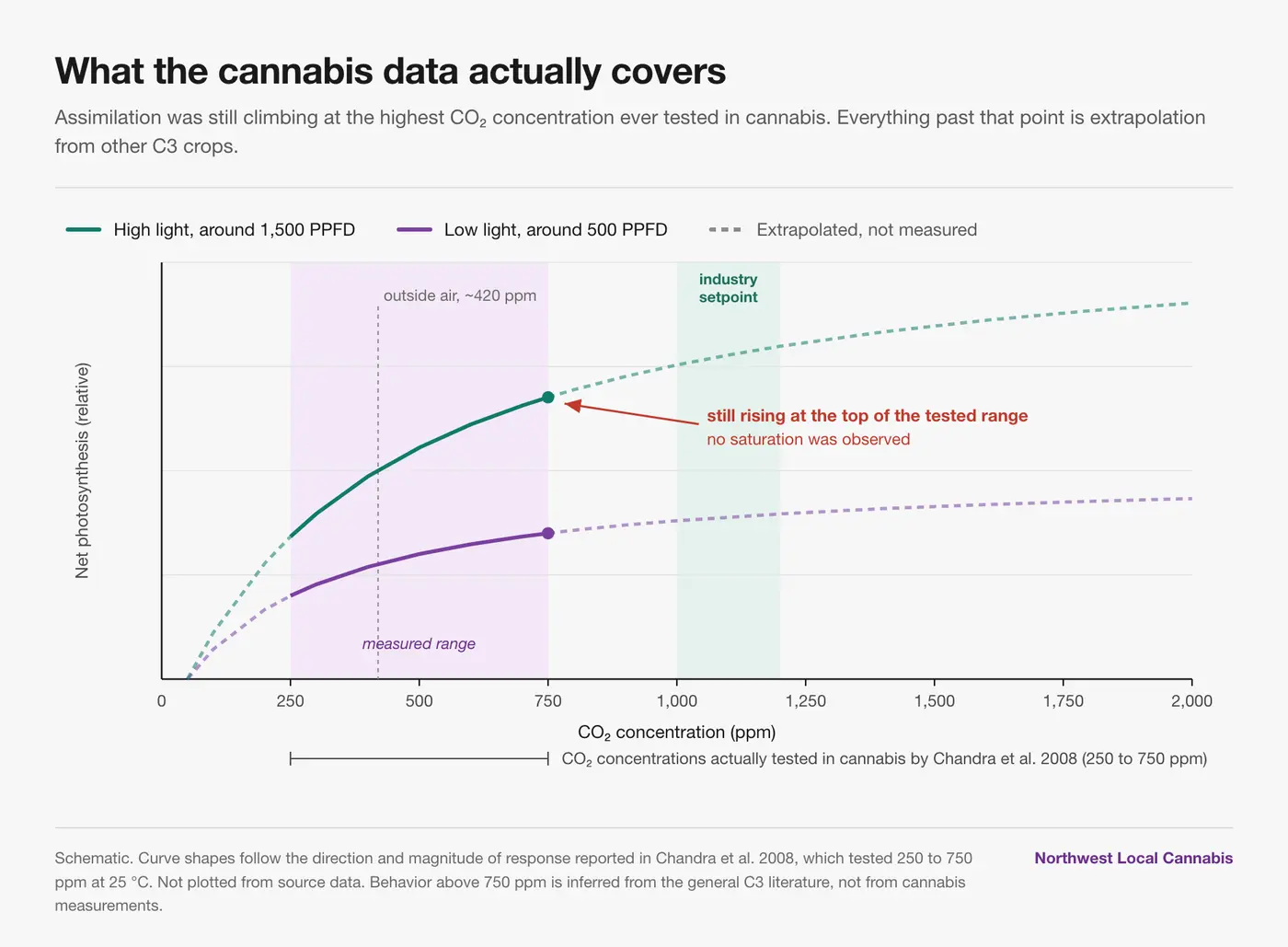
So where does the familiar 1,000 to 1,200 ppm figure come from? Not from a published cannabis dose response curve, because there is not one. It comes from the general C3 literature, the cost of gas, realistic leak rates, and worker safety. It is an economic convention that has held up well in practice, and it is better to say that plainly than to dress it up as a plant science finding.
That is where the literature stands as of August 2026, as far as we can find it. It is worth saying precisely, because it is the kind of claim that expires: one well-run dose response trial above 750 ppm would settle it. If there is published work we have missed, or you have replicated data of your own, send it over and we will update this section.
Supported. Enrichment raises net photosynthesis and yield in cannabis. Neither the direction nor the mechanism is in doubt.
Not supported. That CO₂ raises cannabinoid Cannabinoid The class of compounds including THC, CBD and CBG, produced in the glandular trichomes of cannabis flower and responsible for its psychoactive and medicinal effects. concentration. Potency per gram tends to hold flat or dip slightly while total grams go up. You are growing more flower, not stronger flower. Specific yield-lift percentages at specific ppm values circulate widely online, but they trace back to vendor copy rather than to a study you can actually read.
Not supported. That 2,000 ppm beats 1,200. There is no cannabis data either way above 750 ppm. What is well established across C3 crops is that the response curve flattens, and that sustained very high CO₂ can trigger photosynthetic acclimation, where a plant reduces its RuBisCO content over time. Higher is not better. It is more expensive, and it widens your exposure risk.
Everything that moves when you turn the gas on
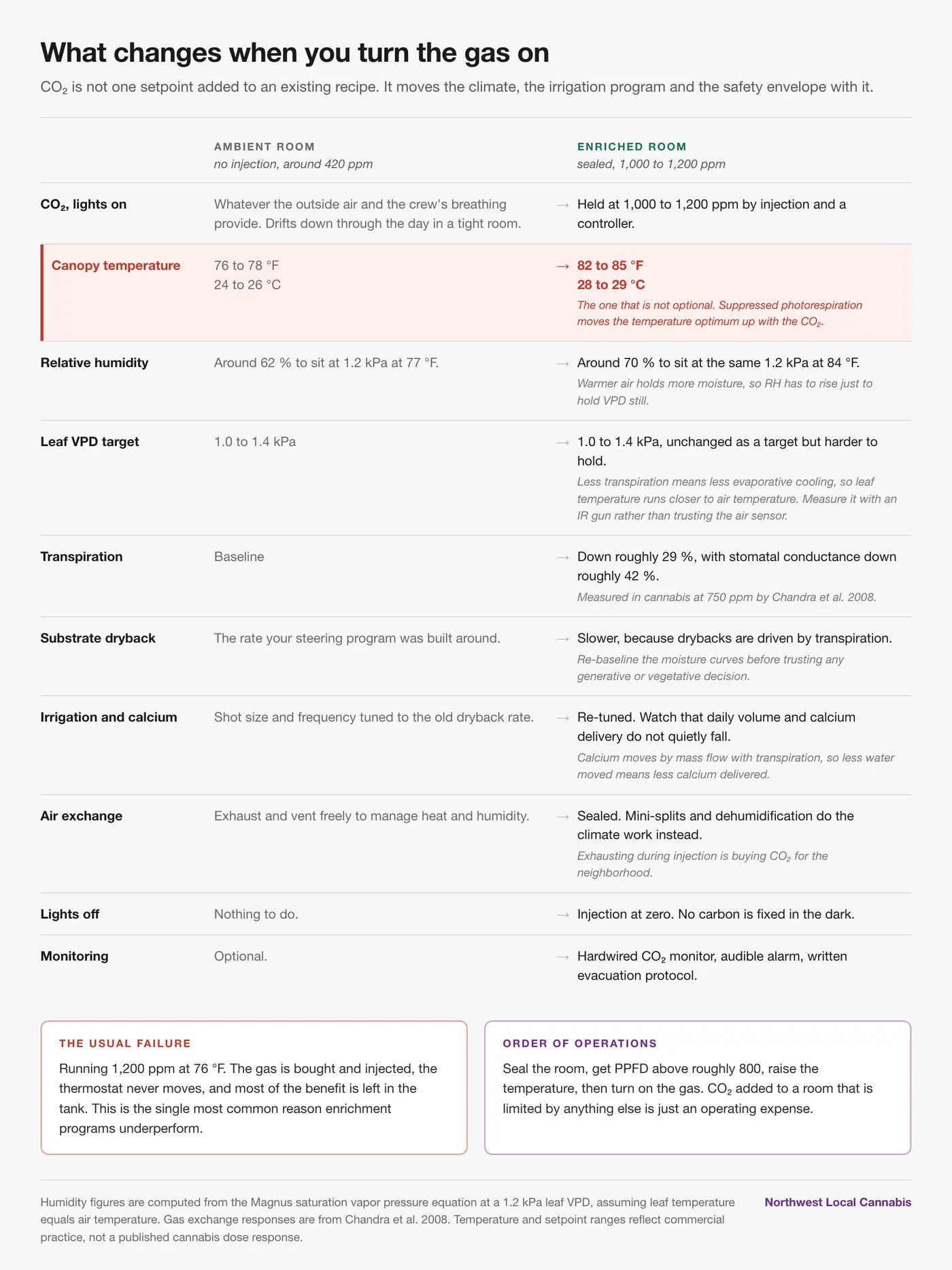
This is what separates a program that pays for itself from one that does not. CO₂ is not a setting you bolt onto an existing recipe. It changes the plant's water relations, and the climate and irrigation strategy have to move with it.
Temperature is the one that is not optional
Photorespiration gets worse as temperature rises. That is the main reason conventional rooms settle at 76 to 78 °F: push warmer without extra carbon and you lose more to the oxygenation reaction than you gain from faster enzyme kinetics.
Elevated CO₂ removes that penalty. With photorespiration suppressed, the temperature at which net photosynthesis peaks moves up, and the crop can finally use the speed that warmth buys. In practice that means canopy temperatures around 82 to 85 °F rather than 76 to 78 °F. The mechanism is reviewed across C3 species by Dusenge, Duarte and Way (2019), though the exact size of the shift has not been measured directly in cannabis.
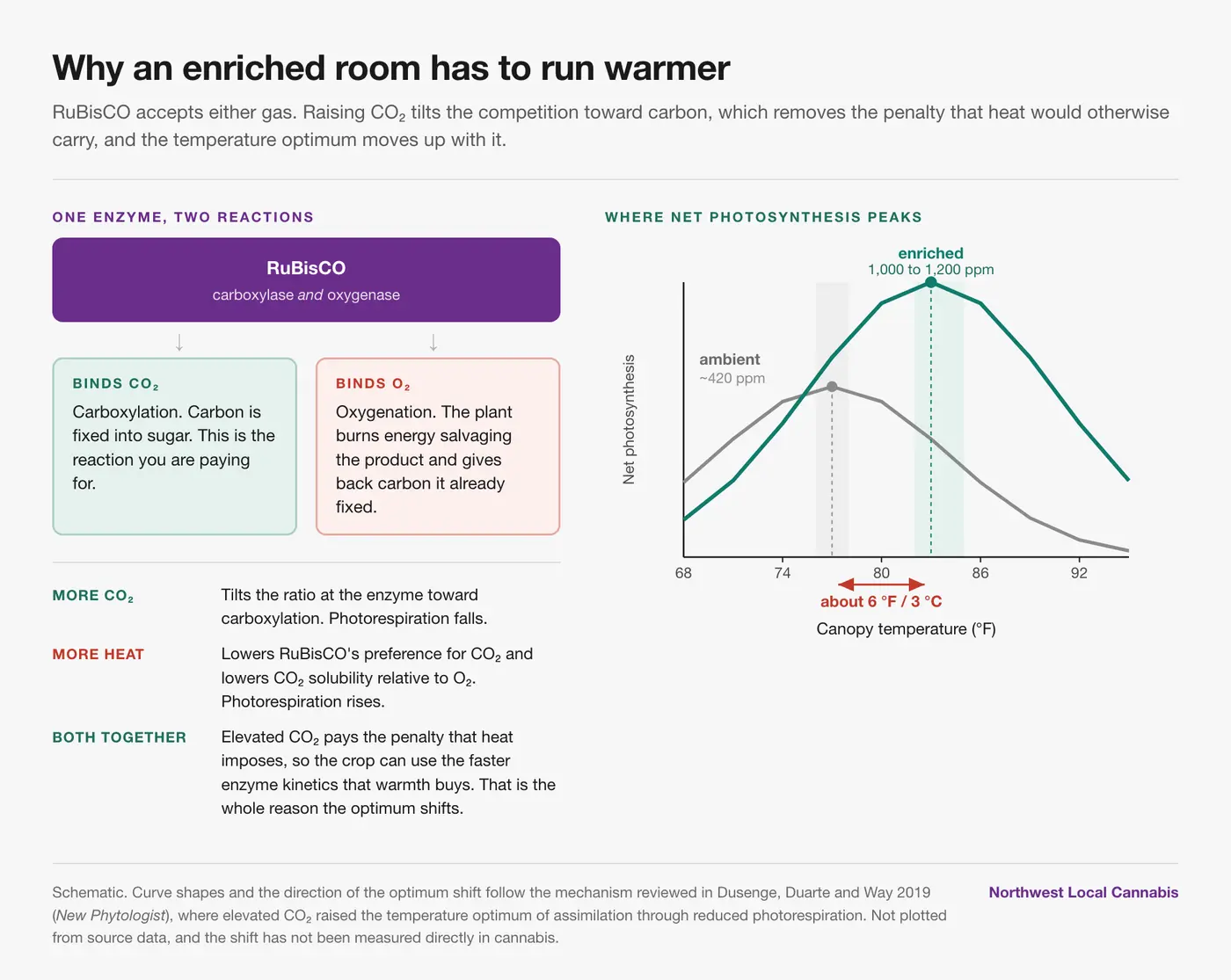
Running 1,200 ppm at 76 °F is the single most common reason enrichment underperforms. The gas gets bought, the thermostat never moves, and most of the benefit stays in the tank. If you change one thing after reading this, move the temperature setpoint at the same time as the CO₂ setpoint, not sometime after.
Humidity has to rise just to stand still
Your vapor pressure deficit Vapor pressure deficit The gap between how much moisture the atmosphere holds and how much it could hold. When VPD collapses, transpiration stalls and calcium stops reaching developing tissue. target does not change. The 1.0 to 1.4 kPa window still applies. But warmer air holds more moisture, so holding the same VPD at a higher temperature takes a higher relative humidity Relative humidity The share of moisture air is holding against the most it could hold at that temperature. Because it moves with temperature, cooling air raises RH with no water added. . At 77 °F, 1.2 kPa works out to roughly 62 percent RH. At 84 °F the same 1.2 kPa needs roughly 70 percent. Rooms that hold the old humidity setpoint while raising temperature end up running the canopy far drier than intended.
One subtlety is worth knowing. Leaf temperature normally sits below air temperature because transpiration cools the leaf. Under enrichment the plant transpires less, so it cools itself less, and leaf temperature runs closer to air temperature than your VPD math assumes. Measure the canopy with an infrared thermometer rather than trusting the air sensor.
Your drybacks slow down
In a coco coir Coco coir A coconut-husk growing substrate. It holds little nutrient charge of its own, so it is fed every irrigation and reacts fast to changes in temperature or EC. or rockwool drain to waste Drain-to-waste An irrigation strategy where runoff is discarded rather than recirculated. Runoff readings become the main window into what the root zone is doing. system, dryback Dryback The share of its water content a substrate loses between irrigations, usually given as a percentage of volumetric water content. It is the central measurement in crop steering. is driven by transpiration. Cut transpiration by something like a quarter and the substrate simply takes longer to give up its water.
If your crop steering Crop steering Deliberately pushing a crop toward vegetative or generative growth by manipulating irrigation, EC, temperature and climate rather than leaving the plant to set its own balance. strategy is built on hitting a target dryback percentage before the first shot of the day, enrichment shifts that timeline underneath you without announcing itself. A room that was steering generatively at a given shot size and frequency can drift vegetative once transpiration drops. Re-baseline your substrate moisture curves after the gas comes on, before you trust any generative or vegetative decision.
Watch the calcium
Calcium reaches the leaf by mass flow, carried along with water. It has almost no phloem Phloem The living vascular tissue a plant moves sugars and dissolved nutrients through. It runs in whichever direction demand pulls, unlike xylem, which only carries water upward. mobility, so it depends on transpiration to get where it is going. Less water moved means less calcium delivered, even with your feed EC unchanged. Watch total daily irrigation volume, and watch calcium in particular.
The room has to be sealed
Mini-splits and dehumidification do the climate work in an enriched room. If you are exhausting during injection, you are buying CO₂ for the neighborhood.
Setpoints by stage
Clones and rooting. Ambient. PPFD PPFD Photosynthetic photon flux density: how many usable light photons land on a square meter of canopy each second, in µmol·m⁻²·s⁻¹. It measures intensity at an instant, not the daily total. is too low for the plants to use the extra carbon.
Veg, 400 to 600 PPFD. 800 to 1,000 ppm.
Flower, weeks 1 to 6, 900 PPFD and up. 1,000 to 1,200 ppm. This is the window where enrichment pays for itself.
Final 7 to 10 days. Taper to ambient. This is primarily a cost decision, plus the fact that plants entering senescence Senescence The natural winding-down at the end of a plant's life cycle, when nitrogen moves out of the leaves and chlorophyll breaks down. assimilate less carbon. The common claim that tapering preserves terpenes is not well supported by available evidence.
The prerequisite underneath all of it is light. Enrichment does very little below roughly 800 PPFD, because a light-limited canopy is not short of carbon in the first place. Fix the light, or the daily light integral Daily light integral (DLI) The total number of usable photons delivered to a square meter of canopy over a full day, in mol·m⁻²·d⁻¹. Intensity multiplied by time, so it captures what PPFD alone cannot. , before you spend anything on carbon.
The daily schedule
- Begin injection 15 to 30 minutes after lights on. Stomata need time to open before the plant can take up anything you inject.
- Hold the setpoint through the photoperiod.
- Cut injection 60 to 90 minutes before lights off.
- Zero at night. Plants do not fix carbon in the dark, so nighttime injection is wasted gas.
Sourcing the gas
Two sources are worth talking about: bottled or bulk CO₂, and colonized mushroom bags. Both get used in this industry. They are not interchangeable, and the reason has less to do with cost than most people assume.
Start with what a room actually consumes. A 40 by 20 ft flower room holds about 226 m³ of air over 74 m² of canopy. Lifting that room from 420 to 1,200 ppm takes about 318 g of CO₂, which feels like the answer but is not, because the canopy then fixes carbon all day long. Two independent estimates, one from canopy assimilation rate and one from the carbon content of the biomass you harvest, put daily uptake between roughly 1.8 and 2.8 kg. That is the number a source has to meet, before accounting for leakage.
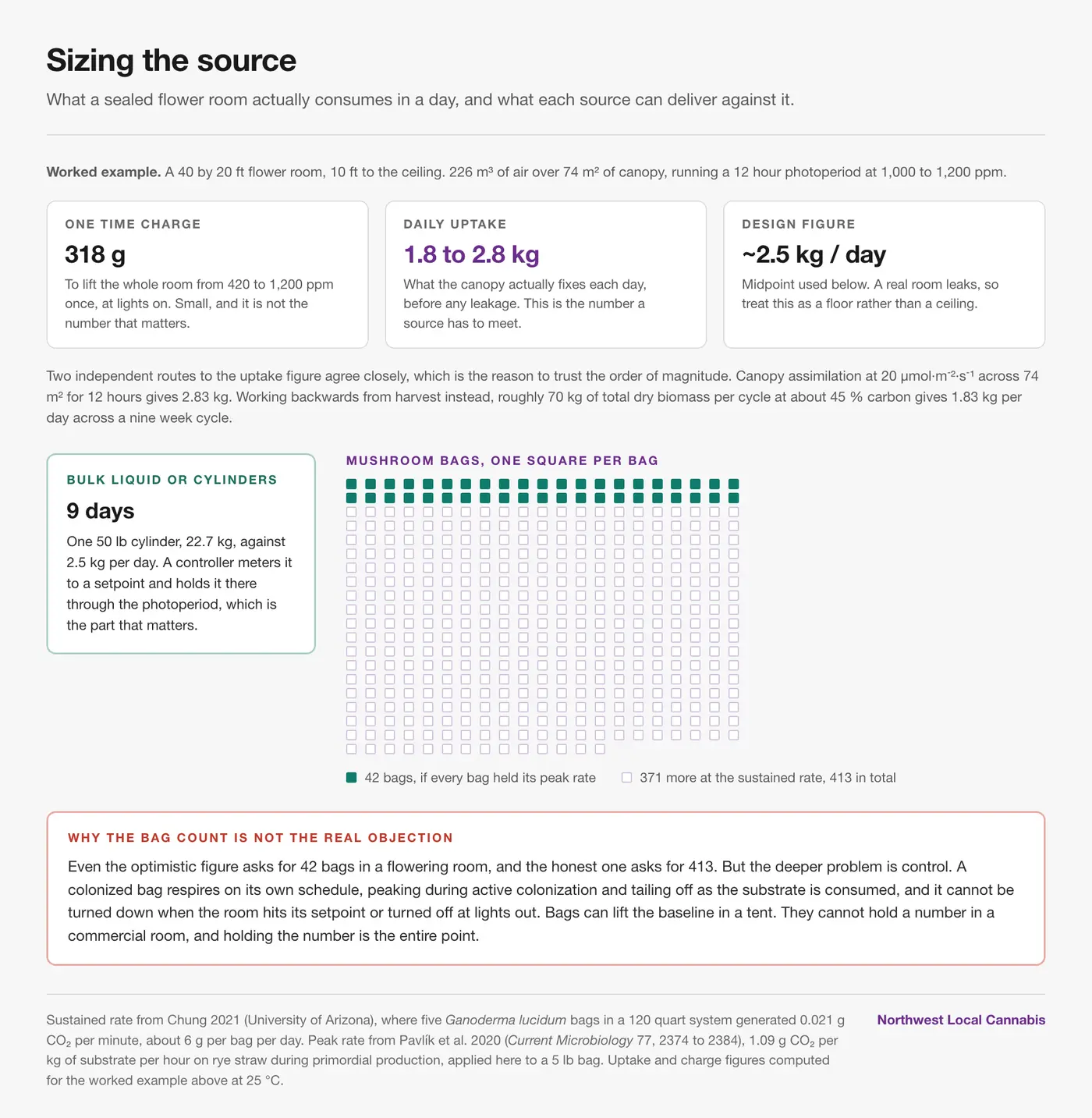
Bottled and bulk. A 50 lb cylinder holds 22.7 kg, so about nine days at 2.5 kg per day, and bulk liquid scales that up without changing anything else. The real advantage is not capacity, it is control. A regulator and controller hold a setpoint and shut off at lights out.
Mushroom bags. A colonized substrate bag respires continuously, and the CO₂ is close to free in the sense that the bag is doing something else useful anyway. Published rates vary a lot by species, substrate and stage. Chung (2021) measured five Ganoderma lucidum bags producing 0.021 g per minute, about 6 g per bag per day sustained. Pavlík et al. (2020) measured up to 1.09 g per kg of substrate per hour on rye straw during primordial production, which works out to roughly 59 g per day for a 5 lb bag at its peak.
Run that against 2.5 kg per day and you need about 42 bags at the optimistic peak rate, or about 413 at the sustained rate. Even the flattering number is a lot of bags to keep in a flowering room.
The bag count is not really the objection though. The problem is control. A bag respires on its own schedule, peaking during active colonization and tapering off as the substrate is consumed, and there is no way to turn it down when the room reaches its setpoint or off when the lights go out. Bags can lift the baseline in a tent or a small room, and that is a legitimate use of them. They cannot hold a number in a commercial flower room, and holding the number is the entire point.
Safety
Whatever the source, install hardwired CO₂ monitors with audible alarms and keep a written evacuation protocol. OSHA's permissible exposure limit is 5,000 ppm as an eight hour time weighted average, so a 1,200 ppm setpoint is nowhere near dangerous in normal operation.
Normal operation is not the scenario worth designing for. A failed regulator or a stuck solenoid in a sealed room with someone working inside it is. That is what the alarm is for.
The short version
Seal the room. Get PPFD above 800. Raise canopy temperature to 82 to 85 °F and let relative humidity rise with it to hold VPD. Re-baseline your drybacks. Then run 1,000 to 1,200 ppm from 30 minutes after lights on until 90 minutes before lights off, and nothing at night.
Do it in that order. CO₂ added to a room that is limited by anything else is just an operating expense.